
Dictionary of Occult – Hermetic and Alchemical Sigils


PDF for download
PAHALIAH
Génie 20
vocale : pahalÿah
évocation du 5° au 9°59′ du cancer,
domine les 19° bélier / 1° cancer / 13° vierge / 25° scorpion / 7° verseau
chaque jour durant 20′, 6h20′ aprés le lever du soleil.
Il règne sur le physique et les actes de ceux qui sont né du 27 juin au 1er juillet.

PALESTINIAN SCRIPT See HEBRAIC SCRIPT
PAIMON
Demon – PAIMON « master of infernal ceremonies »

PALLAS
Ast. Perhaps the earliest sigil for this ‘planet’ (which is in fact an asteroid) in orbit between Mars and Jupiter is given by WILSON 1819

WILSON 1820

SHEPHERD 1971

PANTHEISM See ORIGIN
PAPAL CROSS See CROSS
PAPILIO
Ast. Twenty-fifth of the mediaeval lunar mansions, called Al sa’d al ahbiyah in the Arabic astrological system, a sigil for which is given in MANSIONES 14C :

PARNIEL
Demon – PARNIEL « first lord under Veguaniel »

Mag. Sigil for spirit (perhaps Parmiel was intended) given by HEYD0N 1664 to represent the letter P in the secret writing called the ‘Alphabet o£ Angels and Genii’ :

PARS
Ast. Whilst there are very many different Arabian pars – one for each planet save the Sun – the name by itself usually refers to Pars Fortunas, the ‘part of fortune’, which is the hypothetical point occupied by the Moon if the Sun were to be on the Ascendant of the figure under review. The common modern sigil is given {for example) by LILLY 1647 :

When another pars is to be Indicated, the normal procedure is for the standard sigil to be given, followed by one of the sigils for the relevant planet : for example, the ‘part of Mercury’, sometimes called the part of commerce, may be set out :

FREGOSUS 15C

HOROSCOPES 15C

HOROSCOPE 1614

ASTROLOGY 17C

COLEY 17C

SIBLY 1790

WILSON 1819

STRAGGLING 1824

RUDHYAR 1936

OMONT 1894 gives a Greek sigil derived from the word klipos, though this is a general term, there being many such purs in Greek astrology (see for example DAIM0N) :

PARS CUM PARTE
Alc. ALCHEMICAL 17C

DIDEROT 1763


GESSMANN 1906


PARS FORTUNAE See PARS
PART
Alc. The mediaeval sigils given by GESSMANN 1906 refer to quantity, and have nothing to do with PARS :


PASA See ANKH
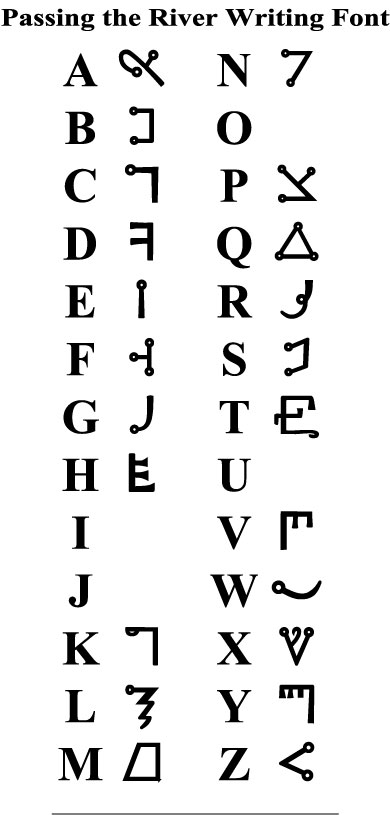
Passing the River Alphabet
PASSIVE INTELLECT
Occ. Sigil originated by KOCH 1930 :

PASSIVE PRINCIPLE
Occ. A modern sigil given by CIRLOT 1962 for the ‘passive, static principle’ :

PASTE
Alc. Several mediaeval sigils have been recorded by GESSMANN 1906 :


PASTOR
Ast. Twenty-second of the mediaeval lunar mansions, called Al Sa’d al Dhabih in the Arabic astrological tradition, recorded by MANSIONES 14C :

PATINA OF GOLD
Alc. BERTHELOT 1885 records a sigil from the Greek alchemical tradition :

PATINA OF SILVER
Alc. BERTHELOT 1885 records a sigil from the Greek alchemical tradition :

PE
Occ. The 17th letter of the Hebrew alphabet (see HEBRAIC SCRIPT) for which many derivatives and variants have been given within the tradition of secret alphabets, notabiy these recorded by BARTOLOZZI 1675 :


WIRTH 1927 equates the letter with the STAR ARCANUM of the Tarot pack, and with the constellation
Andromeda and zodiacal Pisces- He gives the graphic etymology of the letter form :


and traces this back to the idea of ‘mouth’, which is expressed in an Egyptian hieroglyphic related to RU.
PEARL
Alv. DIDEROT 1763


PEBBLE
Alc. GESSMANN 1906

See also STONE
PENDU See HANGING MAN
PENTAGRAM
Occ. One of the recurrent sigils of occultism, with very many different levels of meaning :

AGRIPPA 1531 reproduces it in symbolic form as representative of the form of the human body, an idea which is expressed in BLAVATSKY 1888, and (through the connexion of the sigil with the planet Venus) in SOMMERHOFF 1701, and in SCHULTZ 1963 (from a heliocentric point of view) – but see MICROCOSMIC PENTAGON.
STEINER 1906 treats it as an ancient sigil of the Third Logos and of the Microcosm itself. In the esoteric tradition the pentagram is linked with the etheric or guintessontiai forces in man, which is perhaps why STEINER 1906. gives the sigil as a symbol of mankind developing itself : ‘it is the star that all wise men follow as did the priest-sages in ancient ages’.
The sigil has a wide and varied application : see for example both DEVIL and POPE.
Les pentagrammes


PERFECTION
Occ. The sigil given by HOMER 1723 to indicate both Perfection and the Universal Quintessence is actually the late mediaeval sigil for the Sun :

HOMER 1757

PERIOD See PRIMORDIAL CIRCLE
PHALEG
Demon – PHALEG « demon of discontent »

Mag. TRITBEMIUS 1503 gives a mediaeval sigil for this planetary spirit of Mars :

Two variant sigils are recorded, one by SCHEIBLE 1848

the other by SHEPHERD 1971 :

PHILOSOPHER
Alc. A mediaeval abbreviation is recorded by CHASEANT 1884 :

SOMMERHOFF 1701

PHILOSOPHER’S STONE
Alc. SHEPEERD 1971 gives the sigil

which is one of the forms for SULPHUR upside-down.
PHILOSOPHIC EGG
Alc. DIDEROT 1763


LUEDY 1928

PHILOSOPHIC LEAD
Alc. FRANCKLYN 1627

SIGNA I7C

PHILOSOPHIC SULPHUR
Alc. VALENTINE 1671

DIDEROT 1763


GESSMANN 1906


PHLEGMA
Occ. Phlegma was originally one of the humours which regulated human temperament, and the sigils listed below are perhaps intended to refer to this humour. However, DIDEROT 1763 gives the Sigil

which Is probably intended to refer to sputum. SCHNEIDER 1962 records for Phlegma, aqua insipida, the sigils


but these forms appear to be derived directly from SOMMERHOPF 1701, who gives a specifically alchemical definition for the tetrm, and calls it Aqua Mexourii prima.
WORLIDGE 1651

FRANCKLYN 1627

SHELTON 17C


See also TEMPERAMENTS.
PHLOGISTON
Alc. BERGMANN 1785

DIDEROT 1763

PHOSPHORIC ACID
Alc. SCHEFFERS 1775

PHOSPHORUS
Alc. DIDEROT 1763

HASSENFRATZ 1787

DALTON 1808

LUEDY 1928

PHUL
Mag. TRITHEMIUS 1503 gives a nediaevai sigi for the plaretary spirit of the Moon :

SCHEIBLE 1848

SHEPHERD 1971

PILGRIMAGE
Occ. A siqil which was perhaps invented by KOCH 1930 is obviously intended to express the idea or ‘pilgrimage through life’, or sane? such idea :

Within u chiromantic context, TRACTATULUS 15C gives a sigil which is probably intended to re£er to the idea of a religious pilgrimage in the mediaeval sense :

PINT
Alc. Sigils given by DIDEROT 1763 for the measure of 0.9 litres liquid :


PISCES – POISSONS

Ast. Sigil fcr the zodiacal sign of the ‘Fishes’, derived in ito printed font from the later mediaeval manuscript tradition, as for example in BONATTI 15C

but ultimately derived from Graeco- Byzantine forms, as in NEUGEBAUER 1959 below. The sigil is said by AGRIPPA 1510 to be based on the shape of the fishes, though graphic explanations within the framework of esoteric Christian symbolism relate the sigil to CHRIST (see for example MERCURY 1978 and GETTINGS 1978).
Ancient Egyptian
BERLIN 42AD

STOBART 2C


SPIEGELBERG 1911


Graeco-Byzantine
NEUGEBAUER 1959


Mudiaeval :
DIGBY 12C

ASTRONOMICAL 1400

JANUA 14C

LEUPOLDI 14 C

HYGINUS 1482

MANSIONIBUS 1482

FIRMICUS 1499

ASTROLOGICAL 15 C

QUADRANTIS 15C

RAWLINSON 15C

SCALIGER 15C

SCOT 15 C


TABLE 15C

SCHYNAGEL 1500

AGRIPPA 1510

THURNEYSSER 1570

BRAHE 1582

SIGILLIS 17C

BLUNDEVILLE 1602

DARIOT 1557

FOOTE 17C

MAGICI 17C

ASTROLOGY 1719

PYTHAGORAS 18C

BOUCHE-LECLERCQ 1899

NEROMAN 1937

NEERACHER 1967

SIDEREAL 1951

LEUPOLDI 14C gives a sigil for the constellation Pisces.

See also SPIRIT OF PISCES.
PISCIS
Ast. The last of the twenty-eight mediaeval lunar mansions, called Al Batn al hut in the Arabic astrological system, given in MANSIONES 14C :


PLANETARY SPIRITS
Occ. A number of sigils have been preserved from mediaeval aourctis relating to what are now usually called Planetarcy Spirits, though at least one group of these were originally the daemons of the planets, and recorded under such nane by AGRTPPA 1531. The DAIMON of occultism, like the daimon of the Greeks, was not of course the demon of popular lore, though it has been confused, with it in misinformed circles : only the kakadaemon resembled in any way the European demon. Accordingly, to avoid such associations and confusion, the sigils have been preserved under separate entries – see SPIRIT OP JUPITER, SPIRIT OF MARS, SPIRIT OF MERCURY , SPIRIT OF MOON, SPIRIT OF SATURN, SPIRIT OF SUN and SPIRIT OF VENUS. TRITHEMIUS 1522 gives a list of planetary spirits which he called Secundadeis or Intelligencies (the traditional word) , and which have been since called Archangels : these are the tutelary rulers of historical epochs, however, and in TRITHEMIUS 1503 there is to be found a list of sigils attached to certain of the names of these Intelligences, though it is likely that the planetary spirits of the Epochs are derived (via the Arabs} from the Gnostic tradition, whilst the latter groups which bear similar names are derived from the cabbaliwtic tradition : see the siqils given after the names in the following table, derived from TRITHEMIUS 1503
JUPITER PLANETARY SPIRIT BETHOR

JUPITER PLANETARY ANGEL ZACHARIEL

MARS PLANETARY SPIRIT PHALEG

MARS PLANETARY ANGEL SAMUEL

MERCURY PLANETARY SPIRIT OPHIEL

MERCURY PLANETARY ANGEL RAPHAEL

MOON PLANETARY SPIRIT PHUL

MOON PLANETARY ANGEL GABRIEL

SATURN PLANETARY SPIRIT ARATRON

SATURN PLANETARY ANGEL ORIPHIEL

SUN PLANETARY SPIRIT OCH

SUN PLANETARY ANGEL MICHAEL

VENUS PLANETARY SPIRIT HAGITH

VENUS PLANETARY ANGEL ANAEL

PLANETARY SYMBOLS
Occ. The following account relates to a group of sigils termed planetary which must not be confused with the modern application of the term : for the modern usage, see the lists of sigils under the headings of JUPITER, MARS, MERCURY, MOON, SATURN, SUN and VENUS. Tho following (alphabetical) list is derived almost
exclusively frora the mediaeval manuscript tradition, and few of the sigils within it have anything to do with thp symbolism common to astrology and alchemy, in spite of the association with the planetary names. Many of these sigils are probably derived from copies of Arabic and oriental letters or words, and have been used almost
exclusively for magical purposes, as for example in prophylactic seals and amulets. An enormous number of these sigils have been preserved in manuscripts, and iz would be both tiresome and ultimately pointless to list more than those which have, for onts reason or another, entered the mainstream of occultism; che list below is therefore a select but incomplete anthology. The sigils are grouped (alphabetically) under the names traditionally ascribed to them, though the specific differences in their use is now somewhat obscure.
ANNULOS
CARDAN 1557 gives the following :
Jupiter :


Mars :

Mercury :

Moon :


Saturn :


Sun :


Venus :


CHARACTERS
Jupiter :
ASTROLOGICAL 15C


CARDAN 1557


LUNAE 15C


Mars :
ASTROLOGICAL 15C


CARDAN 1557


LUNAE 15C


Mercury :
ASTROLOGICAL 15C


CARDAN 1557


LUNAE 15C


Moon :
ASTROLOGICAL 15C


CARDAN 1557


LUNAE 15C


Saturn :
ASTROLOGICAL 15C


CARDAN 1557


LUNAE 15C


Sun :
ASTROLOGICAL 15C


CARDAN 1557


LUNAE 15C


Venus :
ASTROLOGICAL 15C


CARDAN 15C


LUNAE 15C


DIVINE LETTERS
Jupiter :
AGRIPPA 1531


BRAHE 1582


TRITHEMIUS 1503


Mars :
AGRIPPA 1531


BRAHE 1582


TRITHEHIUS 1503


Mercury :
AGRIPPA 1531


BRAHE 1532


TRITHEMIU5 1503


Moon :
AGRIPPA 1531


BRAHE 1582


TRITHEHIUS 1503


Saturn :
AGRIPPA 1531


BRAHE 1582


TRITHEMIUS 1503


Sun :
AGRIPPA 1531


BRAHE 1582


TRITHEMIUS 1503


Venus :
AGRIPPA 1531


BRAHE 1582


TRITHEMIUS 1503


SIGILS
Jupiter :
BRAHE 1582


CARDAN 1557


SIGILLIS 17C


TRITHEMIUS 1503


Mars
BRAHE 1582


CARDAN 1557


SIGILLIS 17C


TRITHEMIUS 1503


Mercury :
BRAHE 1582


CARDAN 1557


SIGILLIS 17C


TRITHEMIUS 1503


Moon :
BRAHE 1582


CARDAN 1557


SIGILLIS 17C


TRITHEMIUS 1503


Saturn :
BRAHE 1582


CARDAN 1557

SIGILLIS 17C


TRITHEMIUS 1503


Sun :
BRAHE 1582


CARDAN 1582


SIGILLIS 17C


TRITHEMIUS 1503


Venus :
BRAHE 1582


CARDAN 1587


SIGILLIS 17C


TRITHEMIUS 1503


See also JUPITEH, MARS, MERCURY, MOON, SATURN, SUN and VENUS.
PLANT
Alc. BERTHELOT 1885 preserves two sigiis derived f r0m Greek alchemical manuscripts :


PLATINUM
Alc. SCHEFFERS 1775

DALTON 1808

PLEIADES
Ast. Mediaeval sigil for the star cluster, sometimes called the Atlantides, in the vicinity of 29° of the constellation Taurus, given by HERMETTIS 13C :


AGRIPPA 1510 gives a variant which has entered the European occult stream of symbolism :

PLUTO – PLUTON

Ast. The most common European sigil (see HONE 1951 below) and the most common USA sigil (see JONES 1969 below) have surfaced from numerous suggestions made since the official discovery of this planet in 1930. The planet was named, and ascribed rulership over zodiacal Scorpio long before its official discovery, by PAGAN 1911, who gave the earliest sigil

which is the graphic equivalent of the negative Mars which had rulership over Scorpio until that time.
Before this, there had been a hypothetical Pluto, claimed by WEMYSS 1927 to be ruler of Cancer and ‘probably the most distant planet from the Sun’. WEMYSS 1927 gives two variants for this hypothetical planet :


but in a later edition of his book (subsequent to the discovery of the modern planet by Lowell) an attempt was made to designate the discovered planet Lowell-Pluto, a name which did not receive wide acceptance, but which may have been instrumental in forming the common European sigil, from the initials of the suggested name :

WEMYSS 1933 suggested the sigil

for his own
Lowell-Pluto.
TRIERENS 1931

RAPHAEL 1933

RUDHYAR 1936

NEROMAN 1937

WALTHER 1939

RAPHAEL 1939


EBERTIN 1950


SEMENTOVSKY 1950

HONE 1951

DEUTSCHE 1961

HADES 1969

JONES 1969

EBERTIN 1970


McCAFFERY 1970

SIDGWICK 1973

KENTON 1974

HAWKINS 1976

MEYER 1976

POLE STAR See CAUDA URSAE
POLISH
Alc. SIGNA 17C

POPE
Occ. WIRTH 1927 relates this 5th arcanum of the Torch pack to the Hebraic letter BE, and accords it the sigil of the PENTAGRAM :

POPULUS
Geo. Sigil for one of the sixteen geomantic figures :

A multitude of variants istars, dots. Floral devices, etc.) is used to denote the same four-fold arrangenent- Populvs is linked by AGRIPPA 1532 with the planet Moon, the element Water, and the zodiacal sign Capricorn. The following sigils lire derived from the late-mediaeval tradition, and are sometimes used to denote tho Koon
itself, as for example in TRITHEMIUS 1503.
AGRIPPA 1531


TRITHEMIUS 1503


POTABLE GOLD
Alc. ALCHYMIA 1563


ONOMASTICUM 1574


ALCHEMICAL 17C

SOMMERHOFF 1701


GESSMANN 1906

SCHNEIDER 1962

POTASE
Alc. VALENTINE 1671

SHELTON 17C


DALTON 1808

GESSMANN 1906 records a larqe nuiaber of mediaeval sigils, among which the following are worthy of note :


SCHNEIDER 1962


See also SAL ALKALI
POTASSIUM
Alc. ALBERTUS 1974

POTASSIUM NITRATE
Alc. SHEPHERD 1971

POUND
Alc. The pound weight is most commonly given a sigillic form from the term libra, as for example in tho list of mediaeval forms recorded by GESSMANN 1906 :


BERTHEL0T 1885 records a sicil from the Greek tradition :

ALBERTUS 1974 gives a sigil

which is almost certainly a poor copy of the common contraction :

POWDER
Alc. Several of the mediaeval sicils below arc used synonymously with those for DUST, and in both cases certain o£ the sigils are derived from an abbreviation of the Latin pulvis.
WORLIDGE 1651


SHELTON 17C

DIDEROT 1763


GESSMANN 1906


POWDER OF BRICK
Alc. SHELTON 17C

DIDEROT 1763

POYEL
Génie 56
POYEL vocale: pöÿel
évocation du 5° au 9°59′ du capricorne,
domine les 25° taureau / 7° lion / 19° balance / 1° capricorne / 13° poissons
chaque jour durant 20′, 18h20′ aprés le lever du soleil.
Il règne sur le physique et les actes de ceux qui sont né du 27 au 31 décembre.

PRAYER
Occ. Two related early Christian sigils are recorded by VERARDI 1972, though with modem (and perhaps imaginative) interpretations : ‘prayer addressed hy the World to God’ :

‘prayer rising to God from the Farthly and Lower World’ :

TESTA 1962 gives three sigils which depict the praying human :


KOCH 1930 gives a highly personalised interpretation of the six-pointed star

as being derived from a graphic form depicting the union of human prayer

with the descending power of God :

PRECIPITATE
Alc. VALENTINE 1671


DIDEROT 1763


GESSMANN 1906

PRECIPITATE OF LEAD
Alc. VALENTINE 1671

PRECIPITATE OF MERCURY
Alc. VALENTINE 1671

SHELTON 17C

SIGNA 17C

PREPARATION
Alc. GESSMANN 1906

PREPARE
Alc. SOMMERHOFF 1701 gives the forms for ‘prepare’, as a direction to the practical alchemist :


SOMMERHOFF 1701 also gives the sigils


Caque secundum artem, which means ‘prepare alchemically’.
PREVIOUS SYZYGY
Ast. Two sigils have survived, but. in bath cases the references are generally to the opposition between the luminaries, rather than to the conjunction. A Graeco-Byzantine sigil is given by NEUGEBAUER 1959

whilst SMITH 16C gives a sigil

which is sometimes preceded by the abbreviation prae to denote the previous conjunction :

or opposition

PRIAPUS TAURI
Alc. GESSMANN 1906 records several sigils, all clearly related to the zodiacal sigil for TAURUS :


PRIMAL POWER
Occ In the graphic system proposed by HONE 1951, the circle is said to symbolise eternity, the never-ending, ‘hence spirit or primal power’. When a dot is placed inside the circle, to produce the modern sigil for the SUN, then ‘the circle…. signifies the beginning of the emergence of the power’

PRIMORDIAL CIRCLE
Occ. BLAVATSKY L888 in her account of the occult theory of time – dealing specifically with the birth of time, and with the earliest cycle of the year – writes ‘The first sign of this primordial circle and cycle made in heaven is the earliest shape of the Ankh-cross

a mere loop which contains both a circle and the cross in one image it is the ideograph of a period, an ending, a tine.
See also ANKH and CROSS
PRINCIPIA See ELEMENTS
PRINCIPIA CHYMICA
Alc. SOMMERHOFF 1701 gives the following sigils for the ‘Chemical Principles’ or Elementa, which are scarcely the Elements of modern science :
SALT

SULPHUR

MERCURY

SPIRIT

EARTH

See also ELEMENTS
PRINCIPIA COKPORUM See ELEMENTS
PRITHIVI
Occ. A sigil which is virtually an equivalent of the occidental EARTH element, given in oriental sourcus r and associated with the Wyladhara, or Root Chakra :

The sigil is said to be of a yellow colour, and is recorded by AVALON 1919.
PROTECTION
Alc. MICHAELSPACHER 1616 gives the sigil

next to the sign or constellation Pisces/ perhaps to symbolise the alchemical process of Projection (which/ needless to say/ has nothing uo do with the occult spiritual technique of Astral Projection, as it is wrongly termed).
PROOF Sec TEST.
PSOHDON
Mag. SCHEIBLE 1848 elves four variant sigils for this spirit :


PSOHDON
Demon – PSOHDON « the inconstant »

PUELLA
Geo. Sigil for one of tho sixteen geomantic figures :

A multitude of variants (stars, dots, floral device etc.) are used to denote the same four-fold arrangement. Puella is linked by AGRIPPA 1531 with the element of Water, the planet Venus, and the zodiacal sign Libra. The following sigils are derived from the late mediaeval tradition , and are sometimes used to denote the planet Venus, as for example in TRITHEMITUS 1503.
AGRIPPA 1531


PUER
Geo. Sigil for one of the sixteen geomantit; figures :

A multitude of variants (stars, dots, floral devices, etc.) is used to denote rhe same four-fold arrangement. Puet is linked by AGRIPPA 1531 with the element of Fire, the planet Mars, and the zoaiacal sign Aries. The following sigils are derived from the late- mediaeval tradition, and are some times used ro denote the planet Mars, as for example in TRITHEMlUS 1503.
AGRIPPA 1531


HEYDON 1664


PUGILLUM
Alc. A rough measure, used by alchemists, and defined as ‘that which may he held in three fingers ‘ or ‘that which may be held between the thumb and the first two fingers’, and limited in application to the measure of powders. GESSMANN 1906 records some mediaeval forms which arc abbreviations :


ALCHEMICAL 17C

PULVERISE
Alc. SIGNA 17C


GESSMANN 1906


PURGATIVE WINE
Alc. SHELTON 17C

PURGE
Alc. SIGNA 17C


PURIFICATION
Alc. SOMMERHOFF 1701


PURIFY
Alc. WORLIDGE 1651

FRANCKLYN 1627

DIDEROT 1763


FRESNE 1683

GESSMANN 1906

SCHNEIDER 1962


PUTREFACTION
Alc. WORLIDGE 1651

ALCHEMY 1650


SHELTON 17C

GESSMANN 1906


PUTREFY
Alc. DIDEROT 1763


But see PUTREFACTION.
PYRITES
Alc. BERTHELOT 1885 records a sigil from the Greek alchemical tradition for copper pyrites :

and a number of related sigils for ordinary pyrites :


PYROPHORUS
Alc. SCHEFFERS 1775

PYTHAGOREAN SIGIL
Occ. The ancient Pythagorean

is explained by BLAVATSKY 1888 in terms of the binary (or ‘Good and Lvil’) detaching itself from the single Monad. A more exoteric interpretation, relating the sigil to ‘choice’, is given by WIRTH 1923, who associates the figure with the LOVERS ARCANUM of the Tarot pack. The sigil is also listed by TESTA 1962 as one of the early Christian forms for the CROSS.


Raymond MARTIN-FABER
 Alchemical Iconography